English
 日本語
日本語 한국어
한국어 français
 Deutsch
 Español
 русский
 português
 العربية
 हिंदी
हिंदी Indonesia
For hospitals, pharmaceutical facilities, research institutions, and other operations handling substantial sterilization volumes, selecting a large-capacity autoclave is not simply a matter of choosing the largest chamber available. The right system must match the daily load profile, packaging configuration, loading density, required cycle types, workflow, and available utilities. A well-selected horizontal autoclave can increase sterilization throughput while maintaining reliable steam penetration and consistent process control.
For high-volume applications, the most important consideration is the relationship between usable chamber capacity and actual throughput. A larger chamber is beneficial only when the facility can load it efficiently, process the required materials within appropriate cycles, and integrate unloading into the wider sterilization workflow.
A large-capacity system becomes appropriate when sterilization demand is too high for repeated small-batch processing to be operationally efficient. Facilities that process large quantities of surgical instruments, laboratory containers, wrapped materials, textiles, culture media, or other steam-compatible loads may benefit from a horizontal configuration.
Horizontal chambers are particularly practical when loads are transferred using baskets, carts, or loading trolleys. Instead of manually lifting numerous items into a small chamber, operators can organize a larger batch and move it into the sterilizer as a defined load. This can reduce handling time and make the sterilization process easier to standardize.
However, high capacity should not be interpreted as maximum chamber volume alone. The useful capacity depends on how much of the chamber can actually be occupied while still allowing steam circulation and appropriate heat penetration.
Capacity planning should begin with the facility's actual sterilization workload rather than the nominal chamber size. A useful calculation considers the number of loads processed per day, the average load volume, the percentage of wrapped or densely packed items, and the available operating hours.
| Capacity Consideration | Why It Matters | What to Evaluate |
|---|---|---|
| Daily sterilization volume | Determines the total processing demand | Loads per shift and per day |
| Load density | Affects steam circulation and penetration | Loose, wrapped, or densely arranged loads |
| Load dimensions | Determines whether baskets or carts fit efficiently | Instrument trays, containers, textiles, and other items |
| Cycle duration | Directly affects daily throughput | Heating, sterilization, exhaust, and drying stages |
| Loading method | Influences operator time and workflow | Manual loading, baskets, or trolley loading |
For example, a facility processing several large loads per hour may gain more from a properly configured horizontal chamber than from a smaller sterilizer operated continuously. Conversely, an oversized chamber can become inefficient if loads are frequently only partially filled.
Not necessarily. Throughput depends on more than chamber volume. Cycle time, loading efficiency, steam generation, vacuum or air-removal performance, drying requirements, and unloading procedures all influence how many usable loads can be completed during a working shift.
A 350-liter chamber, for example, may accommodate substantially more material than a smaller chamber, but that capacity only translates into higher productivity when the facility consistently has appropriately sized loads. If operators regularly process half-empty chambers, the additional volume may not provide a meaningful operational advantage.
This is why capacity should be evaluated together with load frequency. A facility should estimate the average load size rather than selecting equipment based solely on the maximum possible load.
A horizontal autoclave is generally easier to integrate into high-throughput workflows because its chamber orientation supports trolley or basket-based loading. This configuration can be particularly useful when operators need to process heavy instrument trays or multiple containers at the same time.
The horizontal arrangement also makes it easier to organize the sterilization area around defined loading and unloading procedures. Instead of repeatedly handling individual items, staff can prepare standardized load units before the cycle begins.
For facilities with predictable batch sizes, this approach can improve workflow consistency. It also allows sterilization parameters and loading procedures to be documented around repeatable load configurations.
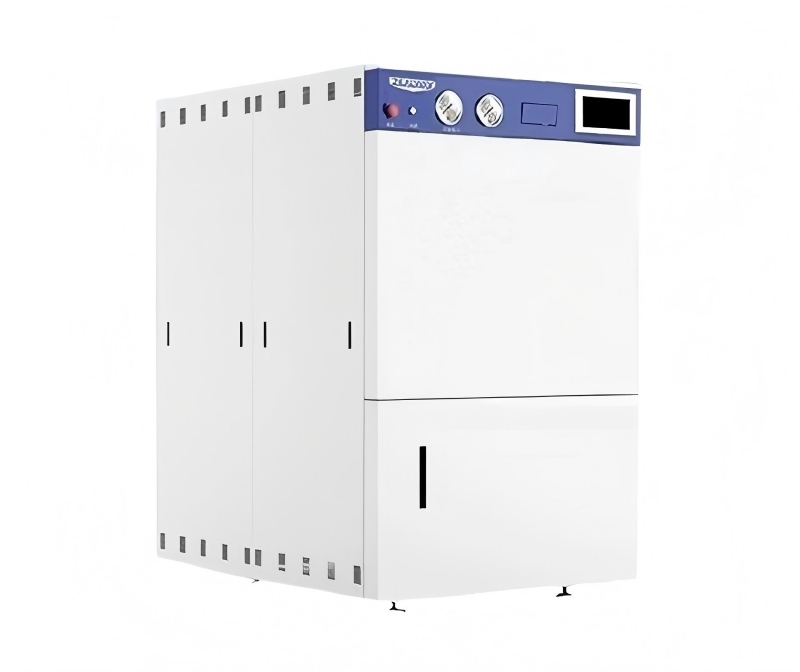
One of the most important considerations in high-capacity steam sterilization is load density. Filling a chamber to its physical limit does not necessarily maximize effective capacity. If items are packed too tightly, steam may not reach all surfaces as required, particularly inside wrapped packs, containers, or complex instrument arrangements.
Large chambers therefore require disciplined loading procedures. Instruments should be arranged to maintain suitable spaces for steam circulation, while containers and packaged materials should be positioned according to the sterilizer manufacturer's loading requirements.
This distinction is especially important when a facility moves from small-batch sterilization to large-batch processing. Increasing chamber size changes the way operators think about load organization, not merely the number of items placed inside the chamber.
A double-door configuration can be valuable when sterilization forms part of a controlled material-flow system. A double door horizontal autoclave can support loading from one side and unloading from another, helping separate pre-sterilization and post-sterilization areas.
This arrangement is particularly relevant to facilities where clean and unclean workflows need to remain physically separated. Rather than returning sterilized loads through the same route used for incoming materials, the equipment can be incorporated into a pass-through workflow.
For larger healthcare, laboratory, and industrial sterilization facilities, this can be more important than chamber capacity alone because workflow design directly affects handling efficiency and contamination-control procedures.
Facilities should compare these capacity classes according to actual load requirements rather than assuming that the largest model is automatically the most suitable.
| Capacity Class | Typical Selection Consideration | Key Question |
|---|---|---|
| Approximately 180L | Moderate-volume batch sterilization | Can the normal daily load be completed without excessive cycles? |
| Approximately 280L | Higher-volume or larger batch processing | Will the additional chamber volume improve load consolidation? |
| Approximately 350L | Large batch and high-throughput applications | Can the facility consistently utilize the larger chamber effectively? |
The correct choice should also account for the dimensions of the items being sterilized. A chamber may have sufficient nominal volume but still be unsuitable if the available loading space does not accommodate the facility's actual trays, containers, or carts efficiently.
In a high-volume sterilization environment, cycle time becomes a productivity variable. A sterilization cycle consists of several stages, including air removal, steam admission, exposure, exhaust, and, where applicable, drying. Extending any individual stage can affect the number of loads completed during a shift.
Drying deserves particular attention when wrapped instruments or packaged materials are processed. A load that has completed the sterilization exposure but remains excessively wet may require additional handling before it can enter the next stage of the workflow.
For this reason, facilities should evaluate complete cycle performance rather than comparing sterilization holding time alone.
A large-capacity autoclave requires more than adequate floor space. Before installation, the facility should verify electrical requirements, water supply, drainage, steam generation or steam-source requirements where applicable, ventilation, door clearance, floor loading, and service access.
Large equipment should also be considered in relation to the movement path from delivery access to the sterilization room. Door dimensions, corridor widths, elevator capacity, and final positioning can all affect installation planning.
Maintenance access is another practical consideration. Sufficient clearance around the equipment allows technicians to inspect components and perform routine service without disrupting the surrounding workflow.
Efficiency is usually improved by combining appropriate chamber capacity with standardized loading procedures. Facilities can establish defined load configurations for recurring instrument sets, containers, or textile loads rather than allowing every operator to arrange the chamber differently.
It is also useful to track actual cycle utilization over time. Records showing average load size, cycle frequency, processing time, and unused chamber space can reveal whether the current equipment is appropriately sized.
Where several sterilization zones are involved, workflow should also be considered. The location of preparation, sterilization, unloading, temporary storage, and distribution areas can have as much impact on productivity as the sterilizer itself.
When evaluating steam sterilizers for high-volume applications, buyers should look beyond chamber volume and examine the complete operating system. Chamber dimensions, loading accessories, cycle configuration, temperature and pressure control, air-removal performance, drying, safety systems, control interfaces, maintenance requirements, and after-sales support should all be included in the evaluation.
The sterilizer should also be matched to the materials actually processed by the facility. Instrument loads, wrapped goods, containers, laboratory materials, and other steam-compatible products can have different requirements, so cycle flexibility may be more valuable than simply increasing chamber size.
The most reliable approach is to start with the real sterilization workload and work backward to equipment capacity. Determine the average and peak load size, identify the materials being sterilized, calculate the required number of cycles per shift, and then compare chamber dimensions, loading methods, cycle performance, and workflow requirements.
A large-capacity horizontal autoclave should ultimately be selected as part of the facility's entire sterilization process. When chamber capacity, load density, cycle performance, material flow, installation conditions, and operator procedures are considered together, the equipment can provide higher throughput without sacrificing the consistency required for dependable steam sterilization.